
[ Get a Demo ]
Ready To See AVA in Action?
See exactly how our AI Voice Agent can be customized for your business. Book a free, no-obligation walkthrough today.
Pick your industry and we'll send you the playbook: real use cases in production and the ROI numbers (no-shows recovered, after-hours leads captured, hours saved).

Drop your details and AVA will call your phone within a minute, with a script tailored to your industry. You'll hear exactly how she'd handle one of your customers.
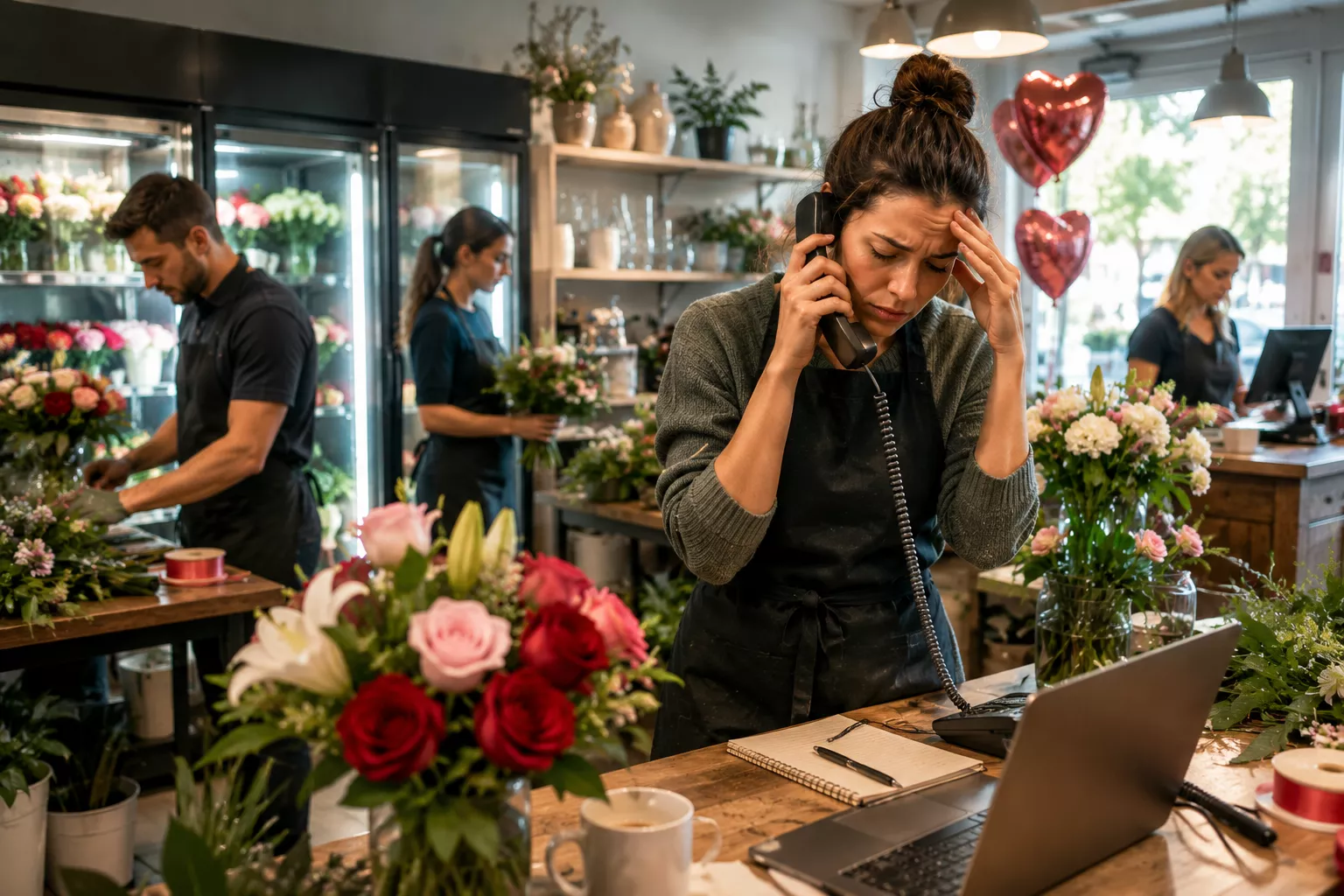
It's 11:47 a.m. on February 13th. Your cooler is packed tighter than it's ever been. Three designers are elbow-to-elbow at the workbench. The delivery driver just called to say he's stuck behind a school bus. Two walk-in customers are waiting at the counter. And your phone - the one you've been watching ring all morning - just went to voicemail. Again.
That caller? They had a $200 order ready to place. They'd been Googling "same-day flower delivery near me" and your shop came up first. They gave you one ring. Maybe two. Then they called the next shop on the list.
This is not a rare scenario. It happens hundreds of times across thousands of flower shops every single February - and again in May. And the wild part is that most florists never see the damage, because missed calls don't show up on a sales report. They just disappear quietly, like revenue that was never there.
Florists are some of the most operationally capable small business owners in retail. You manage live inventory with a short shelf life, coordinate time-sensitive deliveries, handle emotionally charged customers, and produce custom handcrafted products - often all at once, on the same morning.
But there's one operational gap that the Valentine's Day and Mother's Day rush tears wide open every year: inbound call volume that your staff simply cannot keep up with.
During Valentine's week, call volume for flower shops can more than quadruple compared to normal periods. Industry data shows this surge often overwhelms standard staffing levels, with some shops missing up to 40% of incoming calls during peak hours on February 13th and 14th.
Think about what 40% means in real numbers. If your shop handles 80 calls on a normal day and Valentine's pushes that to 300, missing 40% means 120 calls going unanswered. At even a modest average order value, that's thousands of dollars walking out the door before lunch.
For many florists, the Mother's Day weekend alone accounts for more than a quarter of yearly phone-based revenue. Which means the stakes aren't just high during one holiday - they're high twice, in quick succession, with a recovery window of only a few months in between.
This is the revenue leak most florists don't audit. And it compounds quietly, year after year.
Here's what actually happens inside a shop during Valentine's rush that makes call handling so difficult - and why hiring extra bodies doesn't always fix it.
In a small flower shop, your experienced designers are your most valuable resource. During peak season, pulling one of them off the bench to answer calls means slowing production. But putting someone inexperienced on the phone means slower order-taking, more errors, and frustrated customers. It's a lose-lose trade most shop owners end up making anyway.
Valentine's spend in florists peaked between 4pm and 5pm on Valentine's Day, as people make a last-minute dash on the way home from work. That's exactly when your team is at maximum capacity trying to finish same-day orders and coordinate the final delivery run. The phone rings most when you're least able to answer it.
This is one of the most important behavioral shifts happening right now. Studies show that 80% of callers who reach voicemail hang up without leaving a message. Younger customers especially avoid voicemail because they expect real-time responses. Additionally, 67% of people admit to ignoring voicemails even from known contacts, and only 18% listen to voicemails from unknown numbers.
Your voicemail greeting is not a safety net. For most callers, it's a dead end - and the next florist is one tap away on Google.
The urgency around Valentine's and Mother's Day doesn't follow a 9-to-5 schedule. Customers are searching, deciding, and trying to order at 8 p.m. the night before. If your shop is closed and there's no way to capture that inquiry, you're not just missing a call - you're missing a customer who was ready to buy tonight for delivery tomorrow.
AI after-hours answering has become a genuine operational solution for shops that want to capture this demand without keeping staff on the clock.
Understanding why people buy flowers during peak holidays changes how you think about every missed call.
According to the National Retail Federation's 2026 survey, Valentine's Day spending is expected to reach a record $29.1 billion, with flowers purchased by 41% of celebrants - a total of over $3 billion spent on floral gifts alone. That number reflects a specific kind of purchase decision: emotionally motivated, deadline-driven, and deeply tied to the fear of getting it wrong.
When someone calls your flower shop on February 13th at 3 p.m., they're not browsing. They're committed. The decision to buy has already been made. They just need someone to take the order.
That's what makes a missed call during peak season so expensive. This isn't a cold lead. It's a hot buyer with money ready to spend, a deadline tomorrow morning, and exactly zero patience for voicemail.
Industry estimates place the cost of a missed call for florists at approximately $85 when factoring in immediate order value and lifetime customer potential - and during peak seasons like Valentine's Day, this figure can be significantly higher due to premium pricing.
Add repeat purchases, referrals, and the lifetime value of a loyal local customer, and a single missed call on February 13th might cost you ten times the order value over the next few years.
This is usually where the real math starts to sting.
There are four specific breakdown points inside most flower shops during peak season. Recognizing them is the first step toward preventing them.
This is the most obvious problem - and the most expensive. Every call that goes unanswered during Valentine's week is a confirmed lost order, not a lead that might come back. Missed calls are killing growth in business for florists the same way they kill growth in any service business that relies on phone-based revenue.
The challenge is that order calls require your most skilled person on the phone - someone who knows your inventory, can upsell, can handle substitutions, and can quote accurate delivery windows. Most shop owners don't have a spare employee with those capabilities sitting idle during Valentine's rush.
"Where's my order?" calls are an enormous volume drain on Valentine's Day. Customers who placed orders days ago are now anxious and calling for updates. These calls don't generate revenue, but they do consume your staff's time - time that should be going toward answering new order calls or finishing arrangements.
Proactively sending delivery updates reduces inbound "Where's my order?" calls by approximately 70%. Shops that implement automated order status notifications via text or email before the peak period hit find their phone volume drops measurably - and the calls that do come in are almost entirely revenue-generating.
These calls are dangerous because they're emotionally charged and time-consuming. A customer who placed an order two days ago suddenly wants to change the card message, switch from red to pink roses, or add a balloon. Each change requires someone to pull up the order, modify it, check availability, and communicate back to the design team.
This is a legitimate service problem - one that becomes exponentially harder when your staff is already at capacity. Clear order confirmation workflows and a dedicated modification line (or chatbot) can contain these calls without derailing production.
This one is almost entirely avoidable revenue loss. A customer at 9 p.m. on February 13th who wants to place a same-day delivery order for the 14th is a high-intent buyer. If they reach a recording, most of them won't call back in the morning - they'll order online from a national delivery service that answered them in real time.
An AI receptionist for small businesses can handle these after-hours contacts, collect order details, answer basic questions about delivery windows, and flag urgent inquiries for follow-up first thing in the morning - without any additional payroll.
Let's be specific here, because "AI answering service" can sound abstract or complicated when you're running a shop with three employees and a walk-in cooler.
In practice, AI call handling for a florist works like this:
During business hours overflow: When your team is handling walk-ins, filling orders, or managing deliveries and can't get to the phone, an AI system answers in real time. It greets the caller by your shop's name, takes their name and order information, answers basic questions about pricing and delivery windows, and routes anything complex to a voicemail or text notification for immediate callback. Callers don't hear a generic message - they interact with a system that knows your shop, your products, and your policies.
After hours: The same system stays on through the night. A caller at 10 p.m. can get information about next-day delivery cutoffs, place a reservation for pick-up, or leave a detailed order request that appears in your queue first thing the next morning. The order doesn't get lost. The customer doesn't feel ignored.
Peak-period overflow routing: On February 13th, when every line is ringing and every employee is occupied, overflow calls route to the AI system rather than to voicemail. The caller gets a real interaction. You get a captured lead.
This isn't about replacing your staff. It's about ensuring that when your team reaches capacity - which it will, every single Valentine's week - the phone doesn't become a drain on revenue.
The math on this is not subtle. A single AI call handling solution that costs a few hundred dollars a month can prevent thousands in lost Valentine's and Mother's Day revenue - and it works just as hard on an average Tuesday in October when your regular reception is busy.
Shop A runs Valentine's week the traditional way. They have two full-time employees and hire a part-time seasonal helper to assist with production. Call volume on February 13th hits triple digits. The seasonal helper tries to handle the phone while also helping box arrangements. They miss roughly a third of incoming calls. After-hours calls from Sunday and Monday evenings go entirely unanswered.
Their Valentine's revenue is good - but it's a fraction of what it could have been.
Shop B set up an AI call handling system in January. It routes overflow calls during business hours and handles all after-hours inquiries. On the morning of February 14th, they open with a queue of 23 after-hours inquiries waiting to be confirmed. Their team processes those orders before the shop even opens to walk-ins. By 10 a.m., they've already captured more revenue than Shop A will see all day.
Both shops had roughly the same capacity. The difference was purely operational - and it was set up in a single afternoon before the season started.
Most peak-season failures are set in motion months in advance, when the chaos feels far away and there's no urgency to address them. Here's what to actually put in place before Valentine's or Mother's Day arrives.
The consumer expectations around Valentine's and Mother's Day have shifted significantly in the last few years - and they're not shifting back.
Flowers remain one of the most popular Valentine's Day gifts, with 40% of consumers planning to buy them in 2025 - and that figure rose to 41% in 2026, with total flower spending expected to reach $3.1 billion. Demand isn't softening. It's growing. Which means the gap between shops that have operational systems and those that don't will keep widening.
Here's what the 2026 customer expects that they didn't five years ago:
These are not unreasonable expectations. They're just difficult to meet manually when you're one person short on the busiest day of your year.
The shops that will consistently win Valentine's week and Mother's Day weekend aren't necessarily the ones with the best arrangements or the lowest prices. They're the ones that answer every call, confirm every order quickly, and deliver what they promised - without burning out their team in the process.
That's an operational problem. And operational problems have operational solutions.
There's no single fix that transforms Valentine's week from chaos into calm. Anyone telling you otherwise is selling something that doesn't exist.
But there are real, specific decisions that make the difference between a season where you captured 60% of your potential revenue and one where you captured 85%. The gap is almost always in the calls you didn't answer - at 7 p.m. the night before, at noon when your team was buried, or at 9 a.m. when the phone rang fifteen times and nobody could get to it.
Every florist reading this has probably had the experience of finding a missed call from peak season and realizing it was a large order they never knew about. That feeling, multiplied across an entire holiday week, is the true cost of not having an overflow system in place.
The good news is that setting one up has never been easier or more affordable. An AI receptionist for small businesses doesn't need training time, doesn't get overwhelmed on February 13th, and doesn't go home at 6 p.m. It just answers, consistently, every time - which is exactly what your best customers are expecting.
The 2026 Valentine's season already showed the industry that consumer spending on flowers is not slowing down. The question for your shop is whether your operations are ready to capture your full share of it.
Start there. Everything else follows.
See exactly how our AI Voice Agent can be customized for your business. Book a free, no-obligation walkthrough today.