

[ Get a Demo ]
Ready To See AVA in Action?
See exactly how our AI Voice Agent can be customized for your business. Book a free, no-obligation walkthrough today.
Pick your industry and we'll send you the playbook: real use cases in production and the ROI numbers (no-shows recovered, after-hours leads captured, hours saved).

Drop your details and AVA will call your phone within a minute, with a script tailored to your industry. You'll hear exactly how she'd handle one of your customers.
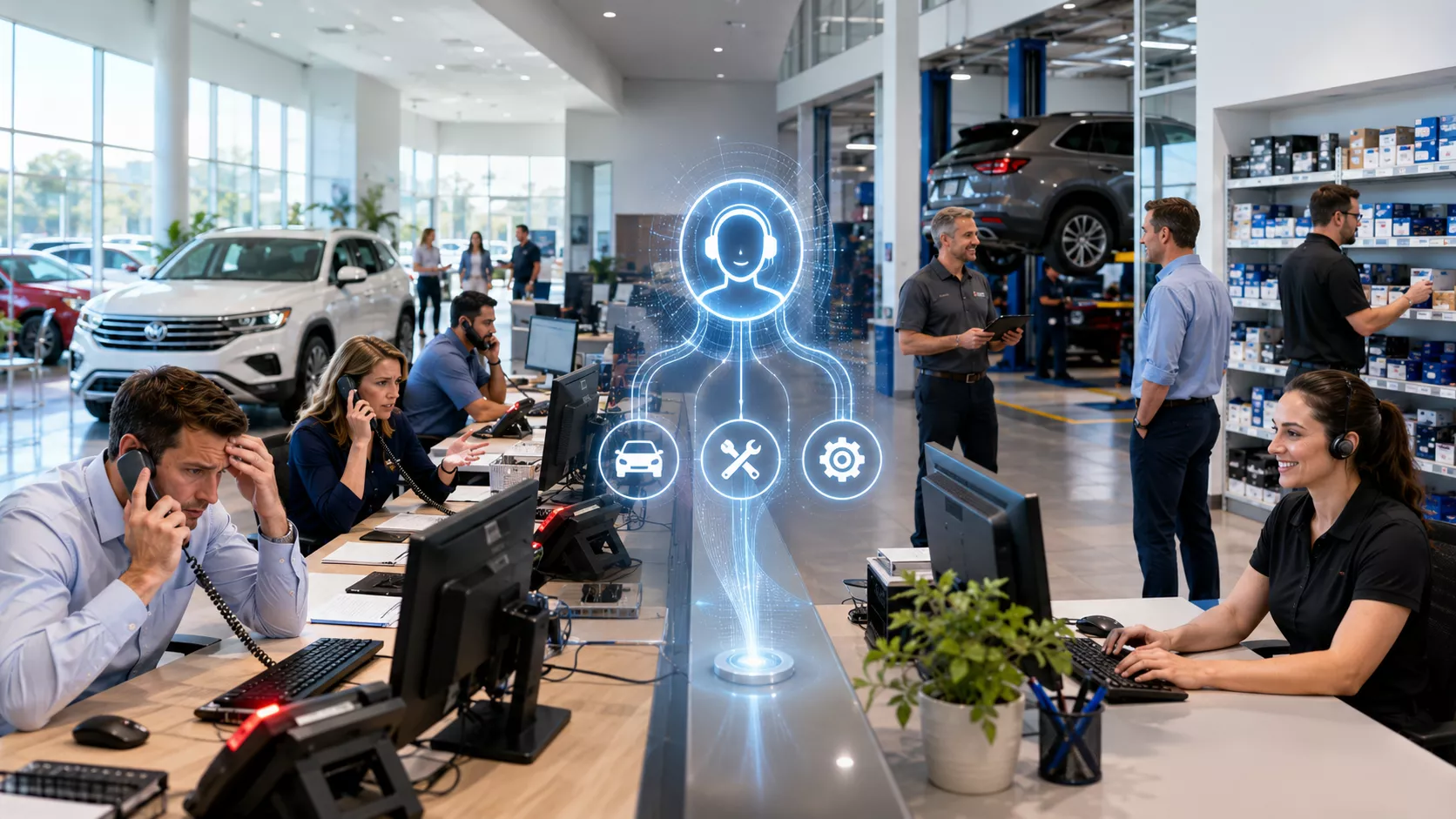
Walk through any busy dealership at 11 a.m. on a Tuesday, and you'll see it: the BDC rep mid-sentence on a sales call when another line rings - this one from a customer asking whether their Tahoe is ready. She makes a quick judgment call and either puts someone on hold or lets a call go to voicemail. Neither is great. One of those callers may never call back.
That scenario plays out dozens of times every day at stores across the country, and most managers either don't know how often it's happening or have simply accepted it as the cost of doing business. But it isn't inevitable anymore.
AI-powered call handling has matured enough in 2026 that dealerships can now route sales calls, service appointment requests, and parts inquiries into completely separate workflows - each handled by a voice agent that actually knows what it's talking about. That distinction matters more than most people realize.
Traditional call handling at most dealerships works like a funnel that wasn't designed for what it's catching. All inbound calls land in one place - usually the main number - and then get routed (or not) based on whoever answers first, what the caller says in the first five seconds, or whether anyone is even available.
The problem is structural. Sales, service, and parts are fundamentally different conversations with different stakes, different information requirements, and different urgency levels. A customer calling to schedule a recall repair needs a different response than someone asking about trade-in values on their 2022 F-150. Lumping them together guarantees that at least one of those customers gets a suboptimal experience.
Research from NADA consistently shows that phone calls remain one of the highest-converting contact channels in automotive retail - yet most dealerships have no systematic way to measure how many of those calls result in nothing. No appointment, no quote, no follow-up. The call just ends.
Here's where things get interesting: the issue usually isn't attitude or effort. Most BDC teams and service writers are doing their best. The issue is that they're being asked to be generalists in a world where customers increasingly expect specialists. Missed calls are costing car dealerships not just in appointment count, but in lifetime customer relationships.
Most dealerships underestimate what poor call routing actually costs them. Let's be specific about the failure modes.
Abandonment before connection. If hold times exceed 90 seconds, a significant portion of callers will hang up. In service departments during peak morning hours, that threshold gets crossed regularly. Those callers rarely leave voicemails - they just call the dealer down the street.
Misrouted calls that burn time. When a parts inquiry gets picked up by a sales rep who doesn't know your parts pricing or inventory, that rep now has to track down the right person, put the customer on hold, and hope the parts counter picks up. Three minutes later, the caller is either disconnected or annoyed. This pattern repeats all day.
After-hours blind spots. A substantial percentage of dealership calls come in outside business hours. Someone's car breaks down at 7 p.m. They call the dealership. They get voicemail. They call an independent shop. That's a service appointment gone for good - and potentially a loyalty erosion that's hard to quantify but very real. Car dealerships lose high-intent leads disproportionately in the evenings and on weekends.
Staff burnout and context-switching. Asking a service advisor to field 40 inbound calls while also managing a live repair bay isn't a workflow - it's a recipe for errors and a high turnover rate. The cognitive load of constant interruption degrades the quality of every interaction.
Before getting into department-specific use cases, it's worth being clear about what modern AI voice agents actually are. They're not the robotic IVR systems from ten years ago that demanded you "press 1 for sales" and made callers want to throw their phones across the room.
A well-implemented AI receptionist for car dealerships uses conversational AI to understand natural language - callers can say what they need in their own words. The system identifies intent (schedule an oil change, ask about a used truck, check on a parts order), pulls relevant data from your DMS or scheduling system, and either resolves the request autonomously or routes the call with full context to the right human at the right moment.
The key word is "context." When a call gets transferred to your service advisor, the AI has already captured the caller's name, vehicle, preferred time slot, and the reason for the visit. The advisor isn't starting from zero. That's a completely different handoff than "I have someone on line two for you."
The real operational gains come from treating sales, service, and parts as three distinct call environments. Here's how that plays out in practice.
Inbound sales calls are your most time-sensitive interactions. Someone calling about a specific vehicle in your inventory has already done their research - they're not browsing, they're deciding. The difference between converting that caller and losing them often comes down to response time and how much confidence they feel in the first sixty seconds.
An AI sales agent can handle the initial engagement immediately - no hold time, no transfer queue. It captures what they're looking for, what they're trading in, their budget range, and their timeline. If they're ready to schedule a test drive, it books the appointment directly. If they want to speak to someone, the transfer includes everything the rep needs to pick up the conversation mid-stride rather than starting over.
This becomes even more important after hours. A customer shopping on Saturday night isn't going to wait until Monday morning for a callback. AVA's AI voice agent handles those conversations in real time - turning what would have been a voicemail into an actual booked appointment.
Service departments are often the highest-volume inbound channel at a dealership, and they're notoriously hard to staff for peak periods. Monday mornings and Friday afternoons are brutal. The phone rings constantly, advisors are tied up with customers at the write-up desk, and something always falls through the cracks.
AI handles service scheduling particularly well because the task is highly structured: identify the vehicle, identify the service needed, check availability, confirm the appointment. The AI can query your shop management system directly, offer available slots in real time, and send a confirmation text or email before the call even ends.
Beyond scheduling, AI can field status update calls - one of the most common and least value-added calls your service team handles. "Is my car ready?" shouldn't require a human. The AI checks repair order status and gives the customer a real answer. That frees your advisors for the conversations that actually require judgment and relationship-building.
Parts callers are a different audience. They're often mechanics, body shop technicians, or DIY customers who know exactly what they want and have zero patience for vague answers. "I'll have to check and call you back" is a conversion killer in the parts department.
An AI configured for parts inquiries can integrate directly with your inventory system and give callers real answers: yes, that part is in stock; here's the price; it can be ready in an hour. For back-ordered items, it can capture contact info and trigger an automatic notification when the part arrives - without anyone on your team having to remember to follow up.
Wholesale parts is an especially strong use case. Independent repair shops calling for multiple parts on a quote often get deprioritized because the call takes time and the counter is busy. AI handles those calls consistently and accurately, which builds trust with wholesale accounts that drive recurring revenue.
Here's a concrete example of how this plays out in a real operational context. A customer calls the main dealership number at 8:47 a.m.
The AI greets the caller and listens for intent. The caller says "I need to get my brakes looked at before a road trip." Service intent is identified within the first sentence.
The AI asks for the vehicle and VIN, cross-references any existing service history in the DMS, and notes that this is a returning customer with a 2021 Chevy Equinox.
It queries open slots in the service scheduler against current bay capacity. It offers two options: tomorrow at 9 a.m. or Thursday at 2 p.m.
The customer picks Thursday. The appointment is written into the system, a confirmation text goes out immediately, and the call ends - total elapsed time: under two minutes. No advisor needed.
If the caller mentions something unusual - "there's a grinding noise and the pedal feels wrong" - the AI flags this for advisor follow-up and routes accordingly, with full call notes attached.
| Scenario | Traditional Approach | AI-Separated Routing |
|---|---|---|
| After-hours inbound lead | Voicemail or missed | Handled & booked instantly |
| Service scheduling at peak hours | Long hold or callback | Immediate, no wait |
| Parts availability check | Counter staff lookup, hold time | Real-time DMS integration |
| Sales call intent qualification | Varies by rep | Consistent, structured capture |
| Repair status update calls | Requires advisor time | Fully automated |
| Cross-department call misdirection | Frequent, wastes time | Eliminated at routing layer |
| CRM data capture per call | Inconsistent, manual | Automatic, structured |
Rolling out AI call handling isn't just a software purchase - it's a workflow redesign. A few things to think through before you sign anything.
DMS integration depth matters enormously. An AI that can only capture names and phone numbers isn't much better than a voicemail. The real value comes from live integration with your Reynolds, CDK, or DealerSocket system - so the AI can actually check inventory, read service history, and write appointments in real time. Ask any vendor exactly what data they can read and write before the demo ends.
Define escalation rules up front. Not every call should be resolved by AI. Upset customers, complex trade-in negotiations, diagnostic questions that require real expertise - these need a human. The AI should recognize these signals and hand off cleanly, with context, rather than looping the caller through a frustrating dead end.
Train your team on the handoff, not just the technology. The best AI implementations fail when the human side of the handoff isn't prepared. Your advisors and BDC reps need to know what information the AI has already captured so they don't ask the caller to repeat themselves. That double-questioning is one of the fastest ways to undermine customer trust.
Start with one department. Most successful implementations don't flip all three departments at once. Service scheduling is typically the fastest to prove ROI because the volume is high and the task is well-defined. Get it working there, measure the results, then expand to sales and parts.
The current generation of AI voice agents is genuinely useful. But what's coming in the next 18 to 36 months is a meaningful step forward.
The fundamental choice here isn't really about technology. It's about whether your dealership wants to compete on responsiveness and consistency or continue absorbing the operational costs of an analog call system.
Customers in 2026 have high expectations. They expect to get answers quickly, they don't want to repeat themselves, and they'll choose a competitor who makes it easier. That's not a pessimistic view - it's just the current landscape.
AI-separated call handling for sales, service, and parts isn't a silver bullet, and it won't replace the human expertise that makes a great dealership great. What it does is remove the friction that prevents your team's expertise from actually reaching your customers. It handles the structured, high-volume conversations so your people can focus on the high-judgment ones.
If you're currently losing calls after hours, watching your service phones spike past capacity on weekday mornings, or seeing parts callers hang up before anyone picks up - those are quantifiable, solvable problems. The technology exists right now to address all three, separately, with a level of conversational quality that customers genuinely don't find jarring.
The dealerships that figure this out early aren't just reducing abandoned calls. They're building a structural advantage in customer responsiveness that compounds over time.
See how AVA's AI voice agent routes and resolves sales, service, and parts calls separately - without putting customers on hold.
Explore AVA for Your Dealership →See exactly how our AI Voice Agent can be customized for your business. Book a free, no-obligation walkthrough today.