
.webp)
[ Get a Demo ]
Ready To See AVA in Action?
See exactly how our AI Voice Agent can be customized for your business. Book a free, no-obligation walkthrough today.
Pick your industry and we'll send you the playbook: real use cases in production and the ROI numbers (no-shows recovered, after-hours leads captured, hours saved).

Drop your details and AVA will call your phone within a minute, with a script tailored to your industry. You'll hear exactly how she'd handle one of your customers.
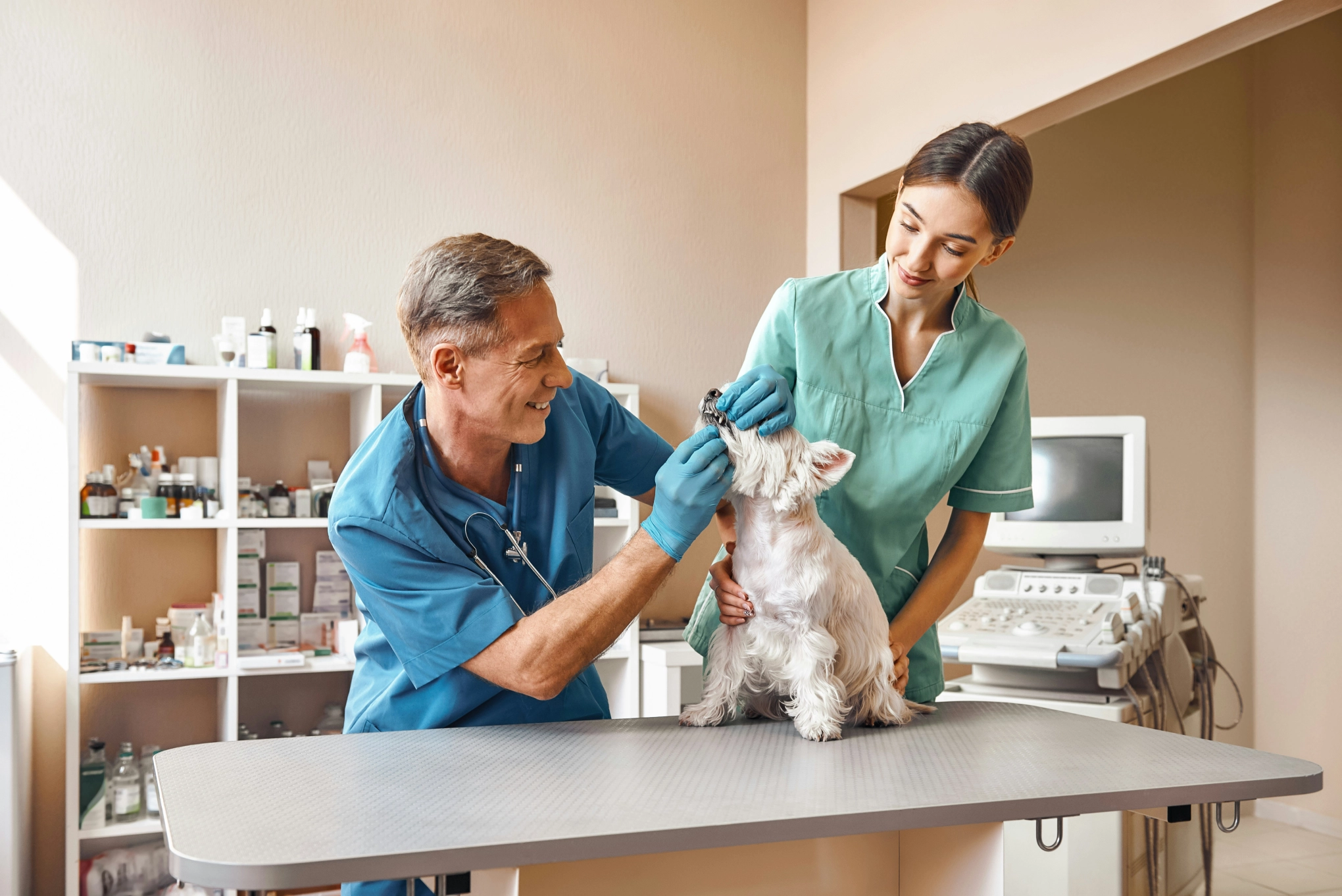
Unlike almost any other small business phone line, a vet clinic's missed call might be a person standing in their kitchen at 9 PM watching their dog struggle to breathe. That's not a hypothetical. Veterinary front desks field a mix of routine bookings and genuine emergencies on the same line, often with no way to tell which one is calling until someone actually answers, and most clinics simply don't have the staff to answer every single time.
That's the core tension this article works through: how a veterinary answering service needs to function differently than a standard business phone system, because the cost of getting it wrong isn't just a lost booking. It's a pet owner who needed guidance and didn't get any.
Most veterinary practices run lean. A receptionist, a vet tech or two, and the veterinarian themselves are often the entire staff during business hours, and all of them are frequently occupied with an animal physically in the clinic. That leaves the phone as the first thing to go unanswered whenever the exam room gets busy.
Unlike a retail business where a missed call just means a delayed sale, a missed veterinary call carries a wider range of possible outcomes. It might be someone booking a routine wellness check who'll simply try again later. It might be someone with a genuinely urgent situation who needs to know immediately whether to come in, call an emergency clinic, or wait. Without answering the call, the clinic has no way to know which one it was, and neither does the caller, who's left guessing whether to keep waiting or find help somewhere else.
Many clinics already use some form of basic answering service, and it's a reasonable first step, but it usually falls short in a specific way: a generic answering service can take a message, but it typically can't distinguish between "please call me back about rescheduling a vaccine appointment" and "my cat hasn't eaten in two days and is lethargic." Both get logged the same way, and both wait for a callback that might not come for hours.
An AI veterinary answering service built specifically for this use case works differently because it can ask the questions that actually matter in the moment: what species and how old is the animal, what symptoms are present, how long has this been going on, and is this an existing patient or a new one. That information changes what happens next, and capturing it while the caller is still on the line is a meaningfully different outcome than a generic message waiting in a queue.
A dog owner calls a clinic at 7 PM after the front desk has gone home for the day. Their dog got into something in the yard and now seems off. With a standard voicemail setup, they leave a message and have no idea when, or if, someone will call back. With a system built for this, the call gets answered immediately, the owner is asked structured questions about symptoms and timing, and depending on the clinic's configured protocols, they're either given clear next-step guidance, connected to an on-call staff member for something urgent, or booked for the first available appointment the next morning if the situation doesn't sound acute.
The difference isn't just convenience. It's the gap between an anxious pet owner getting some form of real guidance immediately versus sitting with uncertainty for an unknown number of hours.
Beyond the urgent cases, a large share of veterinary call volume is entirely routine, and this is where an AI system removes the most friction from daily operations:
Handling this volume automatically frees staff to spend their limited time with the animals and owners physically in the clinic, rather than being pulled toward the phone every few minutes.
Larger veterinary groups, especially those that have grown by acquiring smaller practices, face the same coordination challenge documented in multi-location healthcare and dental groups: each location may have different veterinarians, different specialties (a location with an exotic animal specialist versus one focused on general small animal care), and different scheduling systems if the group hasn't fully standardized yet. A caller needs to reach the right location and the right provider without having to know the internal structure of the practice group themselves, and a system that can't distinguish between locations creates the exact kind of routing confusion that frustrates pet owners already stressed about their animal.
True emergencies need a person, immediately. A pet that's been hit by a car, is having a seizure, or is showing signs of bloat needs a live veterinary professional on the line giving real guidance, not a structured intake flow, however well designed. The right approach here is a system that recognizes these red-flag symptoms during the initial questions and escalates instantly to whoever is on call, rather than trying to resolve the situation itself. This is less about the AI making a clinical judgment and more about knowing precisely where its role ends and a professional's begins.
Clinics bringing this in for the first time generally see the best results by treating the first several weeks as a genuine adjustment period rather than a finished solution from day one. Early calls tend to surface specific scenarios, particular symptom combinations, unusual scheduling requests, that the initial setup didn't fully anticipate, and refining escalation rules based on those real calls tends to matter more than getting the initial configuration perfect.
The financial case tends to be more straightforward for veterinary practices than for many other service businesses, since a single missed new-client exam plus the recurring visits, vaccinations, and eventual specialty care that client typically generates over a pet's lifetime adds up quickly. Running the actual return on an AI voice agent against a clinic's specific missed-call volume and average client value usually makes the case clearer than any general industry benchmark.
A generic small business answering tool isn't equipped for the symptom-triage questions, species-specific intake, or after-hours escalation protocols a veterinary practice genuinely needs. A healthcare AI voice agent configured specifically around veterinary workflows, appointment types, and urgent-care escalation tends to hold up far better than a general-purpose system asked to stretch into a use case it wasn't built for.
Veterinary front desks carry a weight most other small business phone lines don't: on any given call, the person on the other end might just need to book a checkup, or they might be genuinely scared about an animal they love. An AI veterinary answering service built to tell the difference, and respond appropriately to each, changes what happens in that first critical minute of a call far more than simply having someone eventually call back ever could.
It can be configured to recognize specific red-flag symptoms and escalate those calls immediately to on-call staff, but it isn't making a clinical diagnosis. Its role is routing urgent situations to a person quickly, not resolving them independently.
Most owners are more concerned with getting a fast, clear response than with who provides it. The concern shows up when a system attempts to handle something genuinely urgent on its own rather than escalating it.
Yes, though the configuration differs. Emergency and specialty clinics typically need more aggressive escalation protocols and fewer routine booking flows compared to a general wellness-focused practice.
It can collect the necessary details, pet name, medication, prescribing veterinarian, and route the request to the appropriate staff member, though the actual refill approval still requires veterinary sign-off.
Yes. Smaller clinics often benefit the most, since the sole veterinarian and limited staff are the most frequently unavailable to answer calls while treating patients already in the clinic.
See exactly how our AI Voice Agent can be customized for your business. Book a free, no-obligation walkthrough today.