

[ Get a Demo ]
Ready To See AVA in Action?
See exactly how our AI Voice Agent can be customized for your business. Book a free, no-obligation walkthrough today.
Pick your industry and we'll send you the playbook: real use cases in production and the ROI numbers (no-shows recovered, after-hours leads captured, hours saved).

Drop your details and AVA will call your phone within a minute, with a script tailored to your industry. You'll hear exactly how she'd handle one of your customers.
Every small business owner has lived this moment.
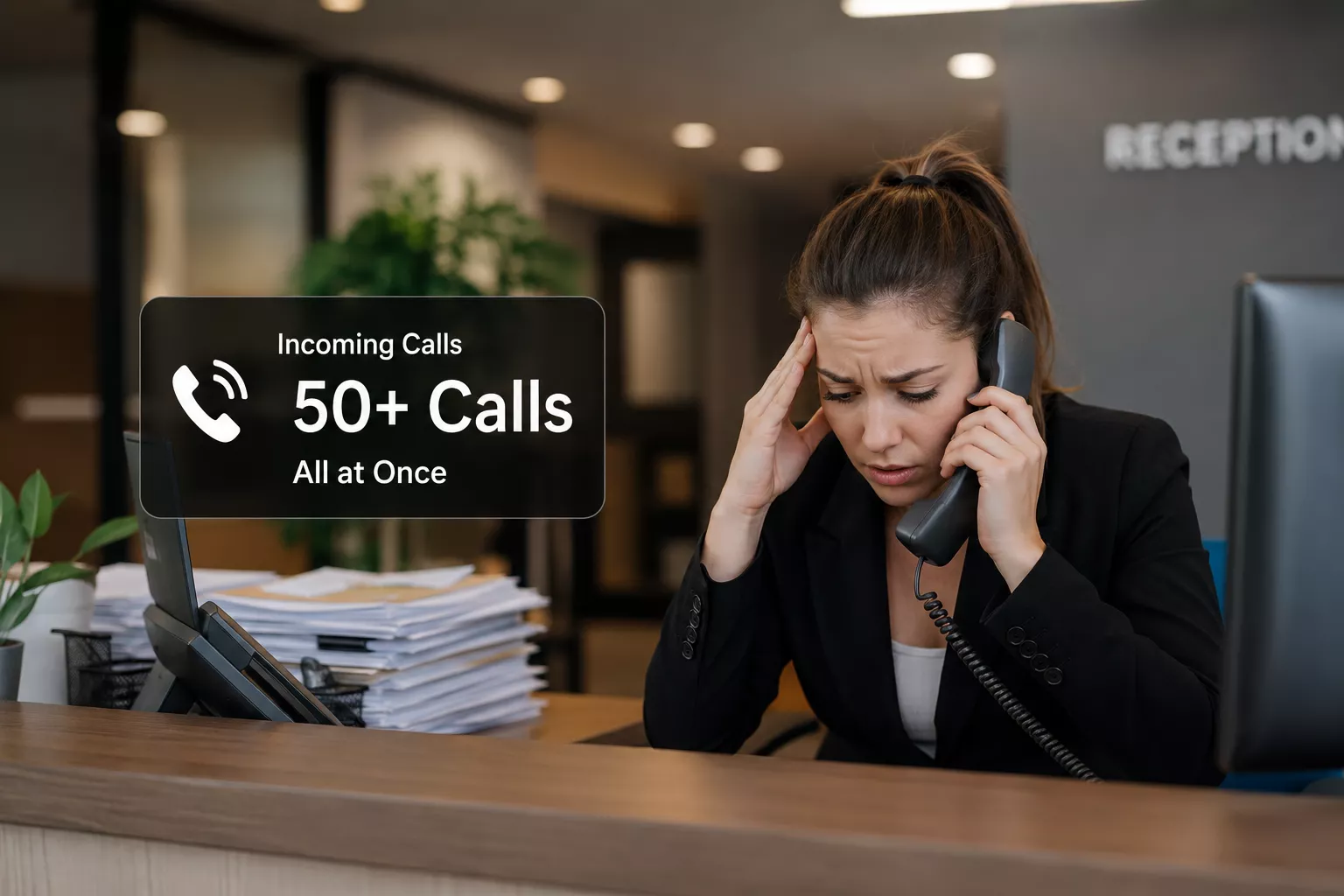
It's 9:03 AM on a Monday. Your front desk phone rings. Then the ring again. Then again. Your receptionist picks up Line 1, puts Line 2 on hold, and Line 3 just goes to voicemail. By the time anyone checks that voicemail, two hours later, that caller has already booked with your competitor.
Now imagine that same moment, but with 50 calls coming in at once.
That's not a hypothetical. That's what happens during peak hours for clinics, restaurants, dealerships, salons, and home service companies every single day. And without call overflow AI, most of those calls become lost revenue.
This article breaks down exactly what happens when call volume spikes, why traditional systems fail, and how AI voice agents handle unlimited simultaneous calls, so your business never sends another busy signal again.
A busy signal isn't just annoying. It's a direct line to lost revenue.
Studies show that 85% of customers who can't reach a business on the first try will not call back. They move on, usually to the next result on Google. For a dental clinic charging $300 per new patient visit, missing five calls on a Monday morning means $1,500 walked out the door before lunch.
And it compounds. Research consistently shows that how missed calls are killing your business goes far beyond that one appointment. A missed first call often means losing a customer for life, along with every referral they would have sent.
The average small business misses between 22% and 40% of inbound calls. During peak hours, that number climbs even higher. This isn't a staffing problem. It's a systems problem.
Most small businesses rely on one of three setups:
One human being can physically handle one call at a time. When volume spikes, callers either reach voicemail or are placed on hold indefinitely. Hold times over two minutes cause 60% of callers to hang up.
These systems route calls but don't actually answer them. A caller pressing "1 for appointments" still ends up waiting or leaving.
Better, but these are human-staffed too. They have capacity limits, shift changes, and quality inconsistencies. They also cost significantly more than AI at scale.
(Check out our AI vs human receptionist cost comparison to see exactly how the numbers stack up.)
The problem with all three is simple: they have a ceiling. When call volume exceeds capacity, the system breaks. Callers hear a busy signal, get transferred to voicemail, or wait so long they hang up.
This is where AI handles multiple calls simultaneously in a way no human system can match.
An AI voice agent doesn't have a capacity limit. It doesn't get tired, go on break, or reach a maximum concurrent call ceiling. When 50 calls come in at once, it answers all 50, in real time, simultaneously, with the same quality and consistency on every line.
Here's what that looks like in practice:
No hold music. No, "your call is important to us." The caller is greeted immediately by a natural-sounding AI voice agent.
Is this a new patient scheduling? A reservation inquiry? A service request? The agent follows a custom script tailored to your business, asking the right questions and capturing the right information.
Integrated with your scheduling software, AI can confirm bookings in real time without any human involvement.
Whether it's call number 2 or call number 52, each caller gets the same attentive experience.
This isn't call routing. It's an AI voice agent call overflow handling, a fundamentally different architecture that scales infinitely with demand.
You can explore how this compares to traditional phone infrastructure in our breakdown of the best AI phone systems for inbound calls.
It's 10:00 AM Saturday. You've got a big sales event running. Your website ads go live. Suddenly, 30 people call at once to ask about inventory, financing, and test drives.
With a traditional system, your receptionist takes Call 1. Calls 2 through 30 ring out or go to voicemail. By the time you call back three hours later, those buyers are already sitting in a competitor's showroom.
With an AI voice agent, all 30 calls are answered instantly. The AI collects names, interests, preferred appointment times, and phone numbers, then routes hot leads to your sales team in real time.
Mondays at medical or dental clinics are notorious. Every patient who feels sick over the weekend calls the moment the office opens at 8:00 AM. Front desk staff gets buried. Patients on hold hang up. Appointment slots go unfilled because the calls weren't captured.
AI front desk handles the entire incoming surge, scheduling appointments, answering FAQs about insurance, and flagging urgent calls for immediate staff attention. No patient goes to voicemail during the critical morning window.
A local restaurant gets featured in a food blog. Reservations explode. The host can take one call at a time. By the time they've booked five tables, another fifteen people have tried calling, got a busy signal, and made reservations somewhere else.
An AI front desk answers every call instantly, confirms availability, books the reservation, and captures a phone number for confirmation, all without a single missed seating.
These aren't edge cases. It's Tuesday.
And the best answering service for small businesses in 2026 needs to be built for exactly this kind of real-world volume.
Let's put real numbers to this.
Say your business gets 200 calls per month during peak hours. With a traditional system, you're likely missing 30% to 40% of those calls, roughly 60 to 80 opportunities.
If your average customer value is $150, that's $9,000 to $12,000 in potential revenue evaporating every month from call overflow alone.
Now eliminate the busy signal. Answer all 200 calls. Convert even half of those previously missed calls. That's an additional $4,500 to $6,000 per month from the same marketing spend you're already making.
Simultaneous call handling for small businesses isn't a luxury feature. It's the difference between a growing business and one that's constantly leaving money on the table.
This is why ThanksAVA is purpose-built as an AI voice agent for small businesses, solving this revenue leak at a price point that makes sense for independent operators, not just enterprise accounts.
Getting started with AI call overflow handling doesn't require an IT team or a lengthy implementation cycle.
What are the most common reasons people call your business? Appointments, pricing, hours, directions? ThanksAVA builds a custom call flow around your specific business type.
ThanksAVA integrates with the tools you already use, whether that's a practice management system, a restaurant booking platform, or a simple calendar.
You decide whether AI should answer all calls, only overflow calls when your team is busy, or just after-hours calls. You control the logic.
Typically within days, not weeks. Your number forwards to ThanksAVA (or replaces your existing system entirely), and every call gets answered from day one.
ThanksAVA provides call logs, transcripts, and performance data so you can see exactly what callers are asking and refine your responses over time.
For a full walkthrough, read our guide on how to set up an AI receptionist for step-by-step instructions tailored to your industry.
Your business doesn't operate on a schedule. Calls come in during lunch, after hours, during your busiest Saturday of the year, and all at once when your latest promotion goes live.
ThanksAVA is built for that reality. No busy signals. No voicemail black holes. No leads slipping through the cracks while your team handles the call they answered two minutes ago.
Every call is answered. Every lead captured. Every time.
Ready to stop losing revenue to call overflow?
Book a free demo at ThanksAVA and see how AI voice agents transform your phone system starting this week.
Yes. Unlike human receptionists who are limited to one call at a time, AI voice agents operate on cloud infrastructure that scales automatically. Whether two calls or two hundred come in simultaneously, each caller gets a real-time, intelligent response with zero degradation in quality.
AVA uses natural-sounding voice AI that handles conversations fluidly, including answering follow-up questions, managing interruptions, and adapting to caller responses. Many businesses choose to disclose that they use AI, while others don't. Either way, callers get immediate, helpful service instead of a busy signal or voicemail.
Not at all. ThanksAVA is specifically designed for small and mid-sized businesses, including clinics, restaurants, salons, home services, and dealerships that experience call spikes but can't justify the cost of a full front desk team. The ROI is often visible within the first month simply from capturing calls that would otherwise have been lost.
See exactly how our AI Voice Agent can be customized for your business. Book a free, no-obligation walkthrough today.