


[ Get a Demo ]
Ready To See AVA in Action?
See exactly how our AI Voice Agent can be customized for your business. Book a free, no-obligation walkthrough today.
Pick your industry and we'll send you the playbook: real use cases in production and the ROI numbers (no-shows recovered, after-hours leads captured, hours saved).

Drop your details and AVA will call your phone within a minute, with a script tailored to your industry. You'll hear exactly how she'd handle one of your customers.
Peak inbound-call periods expose the operational cost of slow answers and inconsistent qualification. Every caller needs a prompt response, relevant questions, and a defined next action. Simply routing calls or sending them to voicemail leaves sales and service teams without context. A useful voice agent must qualify demand, complete appropriate actions, and record the outcome while call volume is at its highest.
This comparison covers:
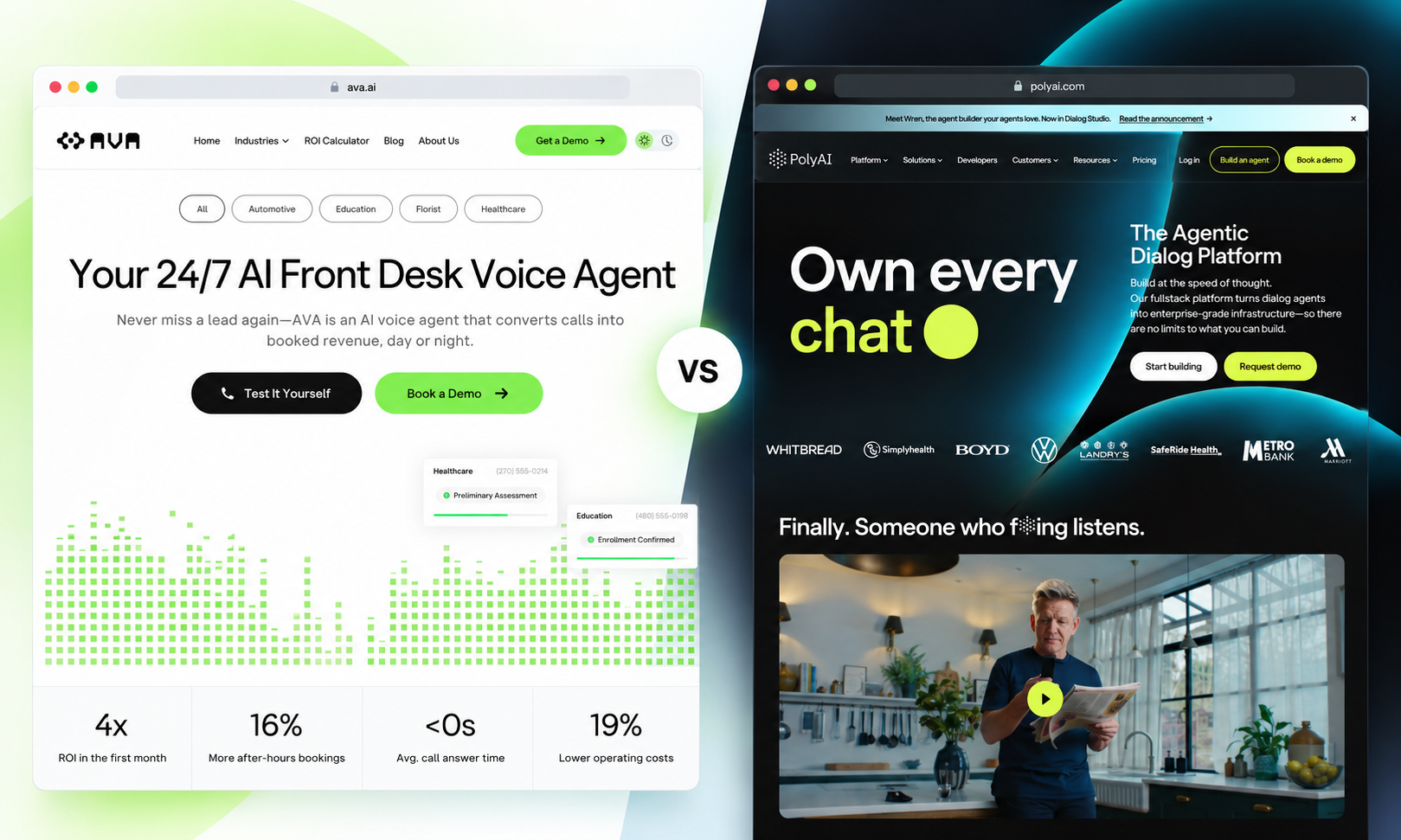
For teams researching AVA vs. Poly AI for handling inbound calls and lead qualification, the central issue is what happens after the system answers. The caller should move through consistent qualification and reach the correct outcome without unnecessary delay.
That outcome could be a transfer to a sales representative, a confirmed appointment, or a structured record for follow-up. The appropriate action depends on caller intent, qualification data, live staff availability, scheduling capacity, and the company’s business rules.
A useful comparison should examine:
Evidence also needs clear boundaries. Documented product capabilities show what a vendor says its system can do. Vendor quotes define the proposed deployment and commercial terms. A controlled test shows whether the configured system can perform the buyer’s workflow under comparable peak conditions.
AVA should only be described as outperforming Poly AI on a metric when both systems complete the same test under equivalent conditions. Until then, AVA’s documented capabilities provide a baseline for evaluation rather than a substitute for observed results.
AVA is a conversational AI system that answers calls naturally, identifies intent, responds to the caller, and captures structured CRM data. Its documented capabilities focus on inbound qualification, appointment booking, routing, and call handling.
Poly AI’s homepage positions the product as an agentic dialog platform for enterprise builders. Its listed use cases include calls, appointments, reservations, insights, and opportunity capture.
A published Poly AI review from 11x characterizes the platform primarily as enterprise customer-service automation [1]. The review emphasizes inbound support, IVR replacement, and service deflection. That is a market perspective rather than proof that Poly AI cannot support a particular sales workflow.
Buyers should ask Poly AI to demonstrate current qualification, booking, CRM, and deployment capabilities using their own inbound-call process.
Peak-call readiness requires evidence across the full call journey. Answer speed matters, but capacity, overflow behavior, qualification completion, and post-call outcomes determine whether the system protects revenue and service quality.
The evaluation should use the buyer’s expected call patterns. That includes normal volume, sudden bursts, calls across locations, after-hours traffic, and requests that require a human.
AVA advertises an average answer time of less than two seconds. Buyers should confirm whether the measurement starts when the carrier presents the call, when the phone begins ringing, or at another event. That definition affects comparisons between vendors.
AVA can answer 50 incoming calls simultaneously in real time. A buyer should still test the configured deployment because telephony, integrations, external APIs, and routing rules can affect end-to-end performance.
For organizations with several sites, AVA can absorb overflow surges across multiple locations in some configurations. This approach can reduce the risk that heavy demand at one site creates a bottleneck for the wider group.
AVA’s healthcare offering reports a 40% reduction in missed calls. That result provides useful context, although it does not predict performance for another organization, industry, or call configuration.
Poly AI buyers should request written details covering:
A category description such as “enterprise voice AI” does not establish performance for a specific peak-call pattern.
A peak-call test should track operational outcomes with definitions agreed upon before testing.
The report should separate technical failures from expected business outcomes. For example, a caller who does not meet the qualification threshold is different from a qualified caller whose CRM record fails to save.
Qualification turns an answered call into structured information and a useful action. During a rush, the system must apply the same required questions and decision rules across concurrent conversations.
AVA can determine what a caller wants and guide that person to a confirmed test-drive or service-appointment slot. The exact workflow depends on the company’s qualification criteria, calendars, routing rules, and integrations.
AVA begins by identifying why the person called. It can then use business-specific scripts to collect information relevant to that request.
AVA’s lead-qualification workflow can capture budget, timeline, purchase readiness, and whether the caller is a decision-maker. A business can use those fields as inputs to routing and follow-up rules.
Required fields should match the sales or service process. A dealership may need vehicle interest, purchase timing, trade-in status, and preferred location. A healthcare organization may require the requested service, location, scheduling preferences, and an approved set of intake details.
Script design should also cover uncertain answers. The configuration needs rules for callers who decline a question, provide conflicting information, change their request, or have several reasons for calling.
A practical qualification flow follows this sequence:
This sequence distinguishes a completed workflow from basic call answering. A call can end without a transfer and still produce a useful result if the system records clear qualification details and the required next action.
Poly AI should demonstrate its equivalent workflow live. The demonstration should use the same qualification fields, caller answers, routing thresholds, calendars, and CRM requirements. Buyers should avoid inferring Poly AI’s questions or scoring logic from its broader platform positioning.
Consider two dealership calls during the same peak period.
A high-intent caller asks about a specific vehicle and wants to purchase it soon. AVA asks the dealership’s required questions, captures the qualification fields, and applies the configured threshold. If the lead meets the rule, the system can route the call to a sales manager with the collected context.
A routine service caller asks for a maintenance appointment. AVA identifies the service intent, collects the required vehicle and scheduling information, checks the relevant calendar, and handles the booking without involving sales staff.
AVA documents the ability to route hot dealership leads to sales managers while handling routine service bookings. This example is one possible configuration, not a universal dealership workflow.
The qualification questions and escalation thresholds must reflect the dealership’s sales process. AVA’s call actions follow the customer’s business logic and connected integrations. Implementation teams therefore need to define what qualifies as a hot lead, which manager receives it, and what happens when that person is unavailable.
An answered call becomes useful when the next team receives enough context to act. The handoff should identify what the caller wants, which qualification criteria were met, what action occurred, and what remains unresolved.
AVA is described as providing structured lead handling and immediate responses. Consistent intake helps reduce variation between calls made during quiet periods and calls made during a surge.
AVA can tag leads by source, urgency, or service type. These tags help a sales or service team decide which records need immediate attention and which can enter a standard follow-up process.
A useful CRM record may include:
Buyers should define the expected schema before a demo. Poly AI should then show whether it can write each required field, summary, disposition, transfer result, and appointment status into the buyer’s CRM.
The test should also inspect unsuccessful calls. A failed transfer, incomplete qualification, or unavailable calendar needs a usable disposition so the team knows what happened.
AVA can read live scheduling data before it commits to an appointment. This protects the workflow from offering times that are no longer available.
Live availability is only one part of booking. Buyers should confirm how each platform handles:
A call advances when the system captures the qualification context, applies a routing rule, commits to an available slot where appropriate, and creates a usable record. Answering without completing those steps leaves work for staff and can delay the caller’s next action.
A controlled evaluation gives both systems the same opportunity to perform. Each vendor should receive identical call scripts, business hours, qualification fields, routing rules, calendars, CRM configuration, escalation logic, and evaluation period.
AVA’s documented capabilities define what it can be asked to demonstrate. Poly AI should demonstrate the equivalent workflow without receiving easier scenarios or different success criteria.
The test set should represent common, difficult, and failure-prone calls. Each scenario needs an expected qualification outcome and next action before the evaluation begins.
Use identical caller answers and system dependencies where possible. If one vendor receives a different CRM, calendar, or telephony setup, disclose that difference in the results.
Tests should include valid requests, incomplete answers, interruptions, corrections, and integration failures. These variations reveal whether the workflow remains accurate when a call departs from the ideal script.
The final report should include:
Define each metric before publishing the result. For example, CRM-record completion should specify which fields are mandatory and whether delayed writes count as complete.
Store scenario scripts, expected outcomes, call logs, CRM records, booking records, and transfer results. Another reviewer should be able to inspect a failed case and reach the same classification.
Publish observed results only. A result from one vendor cannot fill a missing measurement for the other. If a configuration changes during testing, record the change and rerun the affected scenarios under equivalent conditions.
Any winner should be tied to the buyer’s workflow. A company focused on sales qualification may weigh field completion and successful handoffs heavily. An appointment-led operation may prioritize booking accuracy, calendar conflict handling, and CRM synchronization.
A product demonstration should cover the operational work required before launch. Buyers need to know who owns each configuration task, how changes are approved, and what support applies after deployment.
Written answers reduce ambiguity between a successful demonstration and the production system covered by the contract.
AVA uses business-specific scripts to ask relevant questions and capture information for the caller’s request. Those scripts require deliberate design. They should reflect actual qualification criteria, approved language, routing thresholds, and exceptions.
The implementation checklist should cover:
Human escalation needs its own test plan. Ask each vendor what happens when the preferred person is busy, the destination does not answer, the transfer fails, or the caller requests a human outside business hours.
The demo should also show what the employee receives. A transfer without the caller’s intent and qualification context can force the person to repeat the conversation.
Poly AI’s reviewed homepage does not publish a public price and directs prospective buyers toward a demo. AVA pricing should also be confirmed through a written quote rather than assumed from a general product description.
Request a proposal that identifies:
Procurement teams should connect commercial terms to the planned test. A system may perform well in a pilot while requiring different capacity, support, or integration terms for production.
The contract should also state which assumptions depend on the buyer. Examples include CRM access, calendar permissions, telephony setup, security approval, and delivery of qualification scripts.
AVA documents simultaneous inbound-call handling. The available evidence does not establish Poly AI’s current concurrency limits, so buyers should obtain capacity commitments in a technical review. Test whether either platform’s stated capacity includes calls waiting on CRM, calendar, or transfer operations.
AVA identifies intent, asks business-specific questions, captures structured qualification details, and applies configured outcome rules. Poly AI should demonstrate its current qualification process during a live evaluation. Include callers who refuse or partially answer questions so the test covers incomplete qualification.
AVA can route selected callers according to the customer’s business logic. Poly AI’s exact escalation behavior should be verified in a current demo or written proposal. Ask both vendors to show the record created when no person accepts the transfer.
AVA documents appointment booking and structured CRM data capture. Poly AI positions appointments as a use case, while its exact CRM write-back and scheduling behavior requires verification. Confirm that booking identifiers and final dispositions remain consistent across the calendar and CRM.
Implementation requires call-flow design, qualification scripts, integration access, field mapping, scheduling rules, routing logic, testing, and security review. Responsibilities should be assigned to the vendor and buyer in writing. Include a change-control process for updates after production launch.
Pricing depends on the written commercial proposal because public information does not establish comparable terms for both systems. Ask each vendor to separate usage, telephony, implementation, integration, support, and post-launch change costs. The quote should use the same expected call pattern and capacity assumptions.
AVA has documented capabilities for rapid answers, concurrent inbound coverage, business-specific qualification, routing, scheduling, and structured CRM context. Those capabilities make it a strong baseline for organizations that need to advance inbound leads during demand spikes.
A fair Poly AI decision requires the same workflow, call scenarios, integrations, and success definitions. Product positioning alone cannot establish qualification quality or production performance.
Prioritize qualified outcomes, successful next actions, and usable CRM records. Run the standardized peak-call test, retain the evidence, and request written confirmation of unresolved capacity, implementation, support, integration, multilingual reporting, escalation, and commercial requirements.
See exactly how our AI Voice Agent can be customized for your business. Book a free, no-obligation walkthrough today.